
Watch out for wild boars!
The question is, what does one do if one meets a wild boar? Offer it an apple?
There I was, not five minute's walk from our retreat house in Arnoldshain, Germany (about 45 minutes from Frankfurt), and the friend I'm walking with points out a sign that says, “Watch out for wild boars!” I'm from New York City. From taxis I know. What do I know about wild boars? Meeting a wild boar is possibly an experience I could live without!
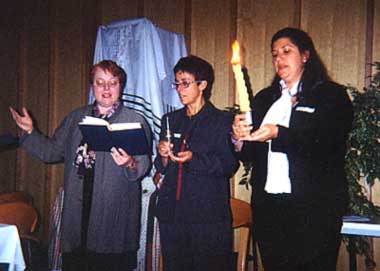
Havdalah in Arnoldshain. Left to right: Rabbi Jo David;
Rachel Dohm, Hameln; and Lauren Reid, Munich. |
|
I was in Arnoldshain this summer representing the Foundation at the annual meeting of the Union of Progressive Jews of Germany, Switzerland, and Austria. I had been invited to teach workshops on Jewish community building because of our work in Hameln. My trip had been underwritten by the Union. Coming to the conference also gave me a chance to visit Hameln and see how our work was progressing.
For a variety of reasons, it was with some trepidation that I prepared for my trip�my first to Germany. All in all, it was a very positive experience. Here are some "souvenirs."
Going to a Holocaust exhibit in Germany is
nothing like walking through an American Holocaust exhibit.
In Frankfurt, I had time before the conference to visit the Jewish museum, which had an exhibit devoted to the (Orthodox) Jewish community that had flourished in Frankfurt before the war.
As I came to the inevitable segment on the Holocaust, the room started to spin. In America, even the best museums have the feeling of it happened THERE. In Frankfurt, all the exhibit cards were written in German. This triggered a sense of it happened HERE that literally took my breath away.
There were several German visitors walking through the museum whom I assumed were not Jewish. One family in particular caught my eye. They were explaining things to their son, who must have been eleven or twelve. I wondered what they were telling him. I wondered how he was processing the information. I wondered if they knew any Jews. Such thoughts would never have occurred to me at the Holocaust Museum in Washington, or at Yad VaShem in Israel.
Fifty German Jews praying in one room is a
rare experience for most Progressive Jews in Germany.
In December, I attended the Union of American Hebrew Congregations Biennial in Orlando, Florida. Shabbat evening, 5,000 of the participants met in one room for Shabbat evening services and there was standing room only. It was a powerful experience to see that many Jews in one room at one time. 5,000. Can you imagine it?
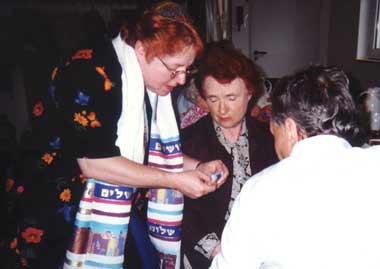
Rabbi David demonstrates to JGH congregation members how to role a piece of parchment to fit into a mezuzzah. |
|
However, welcoming the Sabbath with the 150 Arnoldshain conference participants was an even more powerful experience, simply because most of the Jews in the room had never been with so many Jews at one time before. 150. Can you imagine it? That service was the high point of the conference for many of the attendees.
Despite many difficulties, Progressive congregations in Germany are forming and struggling for existence. Many different efforts are now underway to help these communities grow and prosper. Happily, the Jewish Appleseed Foundation is part of this work, with its growing relationship with J�dische Gemeinde Hameln and with other projects that are under development. In my next report, I'll be writing about the special needs of the 80,000 Russian Jewish immigrants who are a major part of the German Jewish community.
In the meantime, for more information and updates on our activities, please visit the new JGH Web site, JGHReform.org. May you all be blessed with happiness, health and joy in the New Year.
|
|
|


